Wichita has long proved a reliable barometer of American taste — literally. While the overall political and cultural zeitgeist of the metro area may not jibe with the more avant attitudes of coastal settlements, it has almost always been a certainty that if a given restaurant’s fare does well here, it will please Americans from sea to shining sea. For this reason, Wichita is often used as a test market by some of the biggest chains before rolling out new menu items nationwide.
But Wichita’s gifts to our nation’s culinary landscape do not end with the mere Midas touch of our collective palate. Our fair city is also responsible for springing upon the world no fewer than three successful dining chains, together comprising the holy trinity of fast food: burgers, pizza and tacos. Beyond that, the basic format of practically every quick-service franchise in history owes its existence to a pair of visionary Wichitans.
Walter Anderson started cooking up burgers in 1916, operating out of a series of little roughshod stands around Wichita. The first of these was reportedly a retired mule-drawn streetcar that had served as a shoe store before Anderson remodeled it with an $80 loan; legend has it that he got the supplies for his first day in business from a local grocer on store credit. Despite such humble beginnings, Anderson soon managed to expand his business to three locations. In 1921, when he went looking for a fourth, his real estate agent, Edgar W. “Billy” Ingram, suggested they team up, but with a fresh new angle.
At the time, ground beef was looked at with suspicion by many Americans. Upton Sinclair’s novel The Jungle had exposed the less-than-sanitary conditions of the meatpacking industry and the nation’s prevailing attitude considered hamburger meat as little more than glorified dog food. To overcome this lack of trust, Ingram dreamed up a whole new way to present the hamburger as a food product: the White Castle System of Eating Houses.
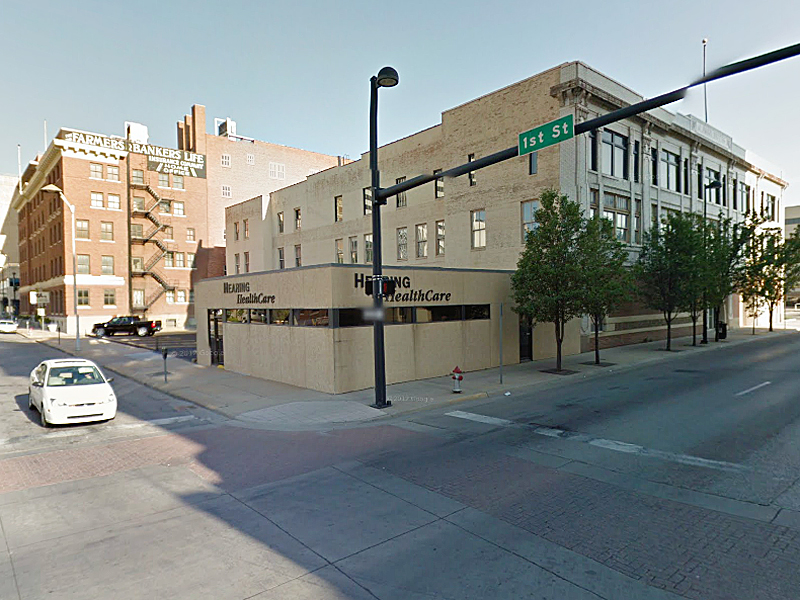
The prototype building, located on the northwest corner of First and Lawrence (now Broadway) was made of steel coated in gleaming white porcelain enamel, shaped like a tiny castle. The interior was a miniscule cathedral of shining stainless steel, manned by well-groomed attendants in spotless white uniforms and paper hats of Ingram’s design. The kitchen was in plain sight of the customer, and the beef— delivered fresh twice a day!— was ground in-house, so nothing unsavory could be hidden within. Everything about the White Castle experience screamed cleanliness, wholesomeness, healthfulness.
White Castle burgers were “sliders” from the beginning, tiny little onion-infused sandwiches sold by the sackful for a nickel apiece. And before long, many such sackfuls were being sold to on-the-go Wichitans. A year after the original location opened, the Orpheum Theatre went into operation across the street, regularly drawing long lines of customers in response to the clarion call of the aroma of grilled onions.
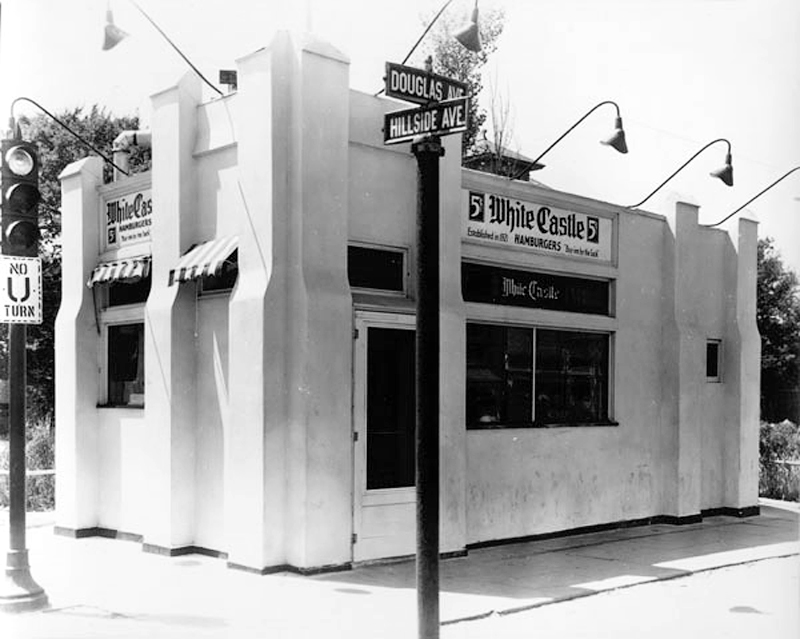
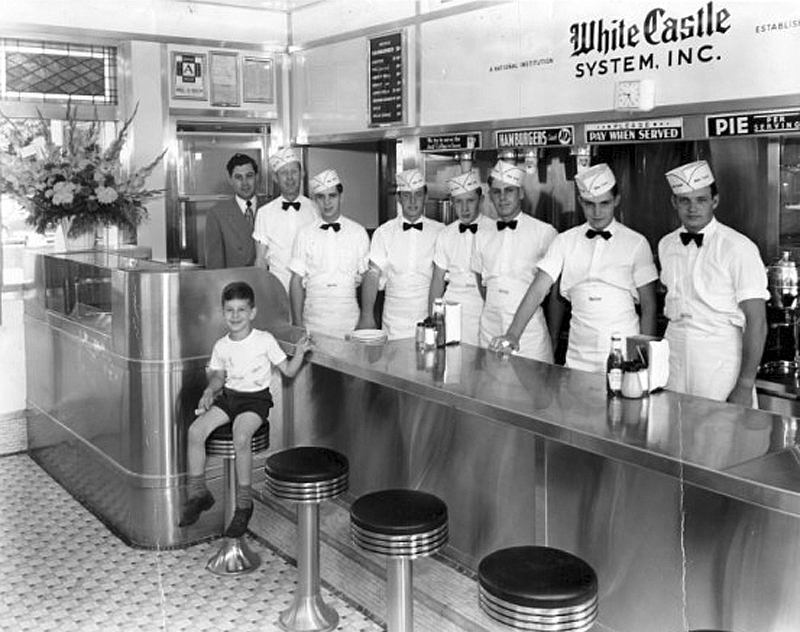
More locations were opened near and abroad, each in a similar building and employing similar methodology. It was America’s first brush with corporate homogeneity; a person walking into a White Castle in Wichita could expect the same experience walking into a White Castle anywhere else in the country. And everywhere a White Castle opened, the locals came in droves.
By 1927 Anderson and Ingram bought an airplane, which Anderson himself learned to fly, so that they could easily travel to other cities to inspect their restaurants. Pioneers of “vertical integration,” they started a company to produce paper hats, sacks and other disposables, and hired an architect to to design their prefab steel buildings, made to be easily moved from one leased property to another if necessary.

When the Depression hit, the poorest Americans— many of whom were among White Castle’s most dependable customers— had a hard time scraping together even five cents for a slider. Ingram worked his marketing magic by reaching out to a higher-income demographic. He even demonstrated the healthy qualities of his product in an early predecessor to Super Size Me, hiring a university professor to monitor a college student as he ate nothing but White Castle sliders and water for eight weeks. At the end of the experiment, the test subject was reportedly in fine health, though the researcher suggested that the company enrich their buns with calcium (which they did). The publicity stunt brought new attention, and new customers, to the chain.
In 1933 Ingram bought out Anderson, who was becoming more interested in airplanes than hamburgers; the next year the company was relocated to Columbus, Ohio, where its headquarters remain today. The last of the original White Castles in Kansas closed in 1938, when a longtime employee named A.J. “Jimmie” King bought the Wichita locations and renamed them King’s X. Wichita’s two Jimmie’s Diners are the only remnants of the company’s history left in town today.
Ingram, a fast food icon in his lifetime, continued running the company until his death at age 85 in 1966. He had seen the company through the economic disaster of the Great Depression and the food rationing of World War II, and during his tenure White Castle became the first restaurant chain to sell a million— and then the first to sell a billion— hamburgers. His son Bill Jr. took over until retiring in 1977, and today the White Castle empire of over 400 stores is run by none other than Billy Ingram the Third.
Next week: Wichita gives birth to a pizza giant and introduces the Midwest to the crunchy taco.
Wichitarchaeology is a series of Wichita history columns originally posted in F5 Weekly. These articles are being presented here as they originally appeared, in some cases with additional photos, supporting links and/or addenda providing updated information. Unless otherwise identified, photographs courtesy of the Wichita-Sedgwick County Historical Museum. This post was first published 4/25/2013.