In last week’s Wichitarchaeology, we covered the story of White Castle, Wichita’s gift to the hamburger world. In this week’s installment, we shall look into our fair city’s contributions in the fields of pizza and tacos.
These days, pizza is as all-American as baseball and apple pie, despite its European roots. One of the key players in its transformation from a rustic, humble Italian flatbread to a staple of our national diet is surely Pizza Hut, founded over half a century ago right here in Wichita.
In the early 1950s, pizza was still an exotic food to most Americans, having established itself as a regular menu item only in big cities with sizable Italian communities. By the second half of the decade, however, pizza pie had become a hot food trend, and new pizzerias began springing up all over the country. Some of these, such as Shakey’s (Sacramento, 1954), Sbarro (Brooklyn, 1956), Little Caesar’s (Garden City, Michigan, 1959), Pizza Inn (Dallas, 1959) and Domino’s (Ypsilanti, 1960), would go on to become successful chain restaurants.
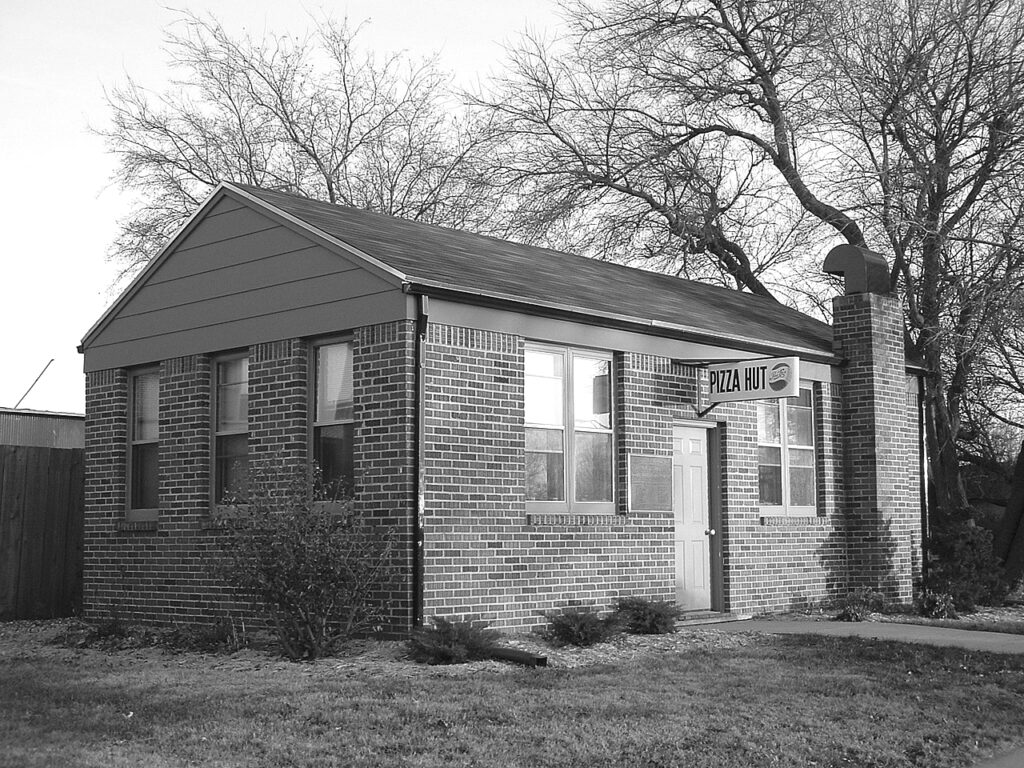
But the biggest of them all started in a tiny brick building near the now-nonexistent corner of Bluff & Kellogg in East Wichita. Pizza Hut was the brainchild of brothers Dan and Frank Carney, both of whom had studied business at Municipal University of Wichita (now known as WSU; didn’t you ever wonder where KMUW got its call letters?). Their parents owned a grocery store, Carney’s Market, on South Bluff.
One day the market’s landlady told them she’d read about the pizza fad in the Saturday Evening Post and suggested the boys try their hand at selling the stuff out of the adjacent building, which she also owned. Seeing an opportunity, the boys borrowed $600 from their mother and with help from Dan’s fellow airman John Bender, who had worked in an Indiana pizzeria, turned what had been a less-than-reputable barroom into the world’s first Pizza Hut.
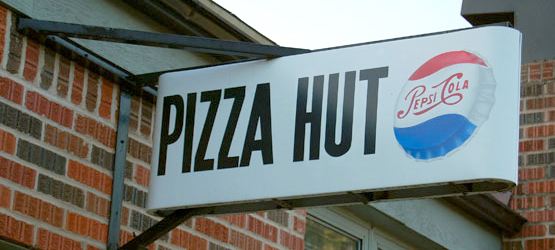
Legend has it the tiny sign over the door, provided by their soft drink vendor, only had room for nine letters on it, including spaces. After “PIZZA” that left only three, and with the shape of the squat little building providing inspiration, “HUT” fit the bill.
From Day One, the Carneys planned to pay back their mother’s investment as soon as possible and open more locations. Within a year a second Pizza Hut opened in Topeka, and soon thereafter there were six locations in Wichita alone. Dan Carney, fascinated by the brand-new field of food franchises, had read extensively about chains like Kentucky Fried Chicken and McDonald’s — both bold experiments at the time. He was convinced that franchising would be the wave of the future, and his vision paid off in spades.
By 1971 Pizza Hut had become the biggest pizza organization in the world, both in number of stores and in sales volume; to this day that status has not changed. The next year Pizza Hut became a publicly traded stock on the New York Stock Exchange, opened its 1000th store (in Wichita, fittingly) and its first outside the United States.
In 1977, when Frank and Dan sold the whole enterprise to Pepsico, their mother’s $600 turned into a $300,000,000 (that’s three hundred million dollars, or more than one billion dollars today) payday. 20 years later, Pepsi’s fast food division, which also owned Taco Bell and Kentucky Fried Chicken, was spun off into its own company called Tricon Global Restaurants, Inc. (which, despite the name, was not run by a cabal of James Bond villains). Pizza Hut’s headquarters left Wichita for Texas, leaving many hurt feelings in its hometown and ending an era in which red roofs were as ubiquitous as Starbucks in the Air Capital. Tricon has since changed its name to the more wholesome moniker Yum! Brands.
Regardless of where its home office may be, Pizza Hut has always been an industry leader in innovation. It was the first pizza chain to offer online ordering (all the way back in 1994!) and even delivered pizzas to the International Space Station in 2001 via a Soyuz rocket. Today there are over 11,000 Pizza Hut stores worldwide (including 826 in China), more than half of them in the United States.
In 1986, the original Pizza Hut building was moved to the Wichita State campus, where it can still be seen today. Dan Carney has spent much of his post-Pizza Hut years following charitable pursuits. Frank later became a major franchisee of Pizza Hut competitor Papa John’s. [Editor’s note: Frank passed in 2020.]
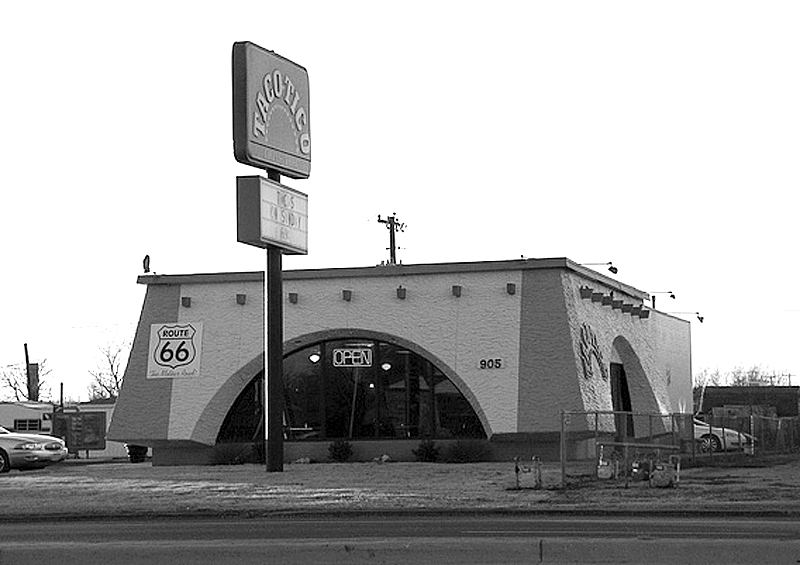
Pizza and burgers are wonderful, of course, but no discussion of Wichita’s fast food successes would be complete without mention of its quick-service Mexican touchstone, Taco Tico.
Like pizza, the humble taco was an uncommon, foreign entree in much of the United States until the middle of the 20th century. Where Mexican culture had a strong influence, however, this quick-and-tasty hand food was a popular item. A California hot dog vendor named Glenn Bell started selling tacos in the early 1950s and by 1962 streamlined his concept into what would become the king of all fast food Mexican joints, Taco Bell.
That same year, Wichita natives Dan and Robin Foley took a similar gamble here in the Air Capital, operating the very first Taco Tico out of a small storefront; the original menu offered only tacos and nachos. Business went well enough that by 1967, the Foleys offered franchise opportunities to entrepreneurs looking to jump on the taco wagon.
Over the next few years Taco Tico expanded, its iconic Southwestern-style buildings sprouting up in other Kansas towns, then throughout the Midwest. By the early 1980s the company had built a solid cult following of folks who couldn’t get enough of the secret Taco Tico meat seasoning, strangely irresistible bean burritos and cinnamon-coated Crustos.
Dan Foley sold the company in 1988 to a group of investors led by former Kentucky Fried Chicken President George Baker. The new owners almost immediately alienated many of the company’s diehard fans by changing the meat recipe in a cost-cutting spree; the ensuing uproar forced a return to the original seasoning.
Taco Tico has not enjoyed the mass-scale success of White Castle or Pizza Hut, but has managed to survive well into the 21st Century in spite of stiff competition from others in the “crunchy taco” market, most notably Pizza Hut’s corporate sibling Taco Bell. There are some three dozen Taco Tico stores open today in Arkansas, Iowa, Kansas, Kentucky, Louisiana, and Oklahoma, and though a handful of them recently found themselves in tax trouble with the State of Kansas, all signs indicate that the chain’s hardcore fan base will keep it afloat for many years to come.
Wichitarchaeology is a series of Wichita history columns originally posted in F5 Weekly. These articles are being presented here as they originally appeared, in some cases with additional photos, supporting links and/or addenda providing updated information. Unless otherwise identified, photographs courtesy of the Wichita-Sedgwick County Historical Museum. This post was first published 5/2/2013.