Author’s Note: This is the second in an ongoing series of memoirs from my youth on the Kansas-Oklahoma border in the 1970s and ’80s. These chapters are intended for mature readers only.

In the spring of 1976, less than a year into life with my stepfather David, my family moved from our rented house at 601 N. 8th in Ark City to an old farmhouse all the way outside of town, at the very north end of that same street. There was a stop sign at Skyline Road and if you continued north you were in our quarter-mile-long dirt driveway, bordered with a line of hedge trees to the east and a bare field to the west. I was nervous about the move, but was glad to know I would still be able to attend the same school. I had already moved once in the past year and had managed to stay at Adams Elementary — only now, due to my rural address, I was to be a bus kid. I wasn’t sure yet how I felt about that.
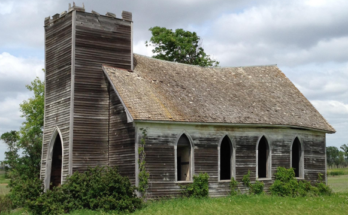
I liked the rickety two-story house, white and wooden and ancient, built probably around the turn of the century. A big upright gas furnace in the living room was the only source of heat in the place and there was no air conditioning. But it was must have been April when we moved in and it seems like the windows were open a lot of the time, letting in the fresh prairie air. The only other people who ever came up our driveway were some guys who had a little spot to the north where they shot skeet a couple times a month; the sound of their shotgun blasts would perforate our evenings, then on days after I would sneak over there past the NO TRESPASSING sign on the gate and look for unbroken clay pigeons lost in the weeds. I found more than a few.
This was maybe four months after my seventh birthday, toward the end of my year in Mrs. Wilcox’s first grade class at Adams (where my mother had, only 18 years before me, been taught by the same teacher in the same room). My little brother Chris was still just a toddler, not yet four years old. Other than the fact that he got sprayed at point-blank range by a skunk almost immediately after we moved in, which meant the entire house smelled like skunk the whole time we lived there, he and I both took quickly to country life. There weren’t any other kids to play with, it was true, but we had a lot of ground to explore and practically zero oversight. And personally, my experiences with other kids had not been uniformly pleasant, anyway, so I didn’t really feel like I was missing much. Fortunately for me, my innate curiosity about the world allowed me the luxury of being entirely able to occupy myself indefinitely without the interaction of others.
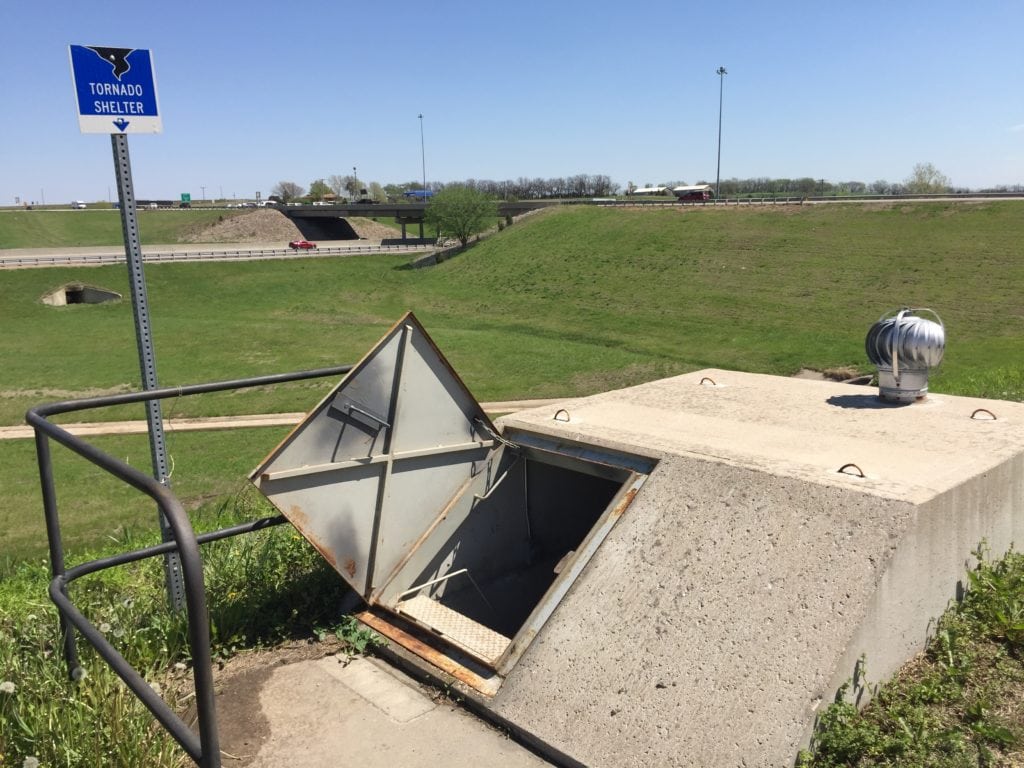
There was a creepy old concrete fraidy hole in the backyard, a hedge against tornados that was also being used by the landlord as a root cellar. On the couple of occasions I was allowed to look inside it, I was fascinated to find it stuffed full of dusty jars of home-canned okra and sand plum jelly and absolutely crawling with thousands of spiders.
The property also had an old wooden garage behind the house, big enough for a car and some workspace, too. David fashioned a small chicken coop under the workbench built inside one end of it, with an opening to a penned-in area outside, and we started keeping hens and ducks. I was tasked with the chore of going out first thing each morning to feed them, a duty I took seriously, as I was promised an allowance of a dollar a week for doing it. I remember vividly being outside on one particularly cold morning, seeing my breath hang in the air as I struggled to get the metal lid off a big cardboard barrel of chicken feed, the birds clucking and cooing in expectation.
We only lived in this house for maybe a year but the memories I made there are among the most vivid of my youth.
First, there was the day David’s hillbilly brothers came over to party at our new digs. David and two of them, I forget which ones now, were standing just inside the open bay door of the garage, drinking beers, shooting the shit and listening to rock & roll on the radio. It was the middle of the afternoon and the spring weather was gorgeous, with everyone standing around bareheaded, winter-white arms sticking out of t-shirt sleeves.
I was outside, just around the corner from them, sticking Lite Brite pegs into the barrel of my pellet gun—a cheap spring-loaded Marksman Repeater pistol made to look like the famous Colt 1911-A handgun — snapping the heads off and shooting the resulting translucent plastic missiles at the large wasp nest under the eave of the garage. (The pegs were of no longer of use to me, as David had on an earlier occasion walked into my room without a word, snatched up my Lite Brite, then snapped the screen out of the front of it and wired a coat hanger to its back so he could use it as a garage drop light while working on his old Dodge. Some time later that summer he would almost set fire to the garage in his attempt to get rid of the wasp nest by spraying some sort of flammable liquid out of a spray can and setting it ablaze with his Zippo lighter.)
I was having fun riling up the wasps but eventually ran out of pegs. I knew there was a tube of BBs in the garage, but I really didn’t want to interact with David and his brothers, as it seemed to me that his unpredictable behavior tended to get wilder when they were together. I sneaked quietly into the side door carrying the pellet gun, and I almost made it in and out without being seen. Almost.
“Hey, bring that over here,” David said, pointing to the gun in my hand.
Great, I thought. I’m sure I sighed. I walked over to David and his brothers and handed him the pistol. He took it, gave it a shake and could tell there were no BBs inside. He set down his beer on the floor of the garage, looked at me and made the “gimme” motion with his empty hand. I handed him the cardboard tube of BBs and he flipped open the loading ramp of the gun and dumped a bunch of the tiny metal spheres inside. I started backing away while his attention was occupied, hoping to just melt back out the side door before he noticed I was gone, but no dice.
Having loaded the gun, David smiled and made a show of cocking it, pulling back the slide and slamming it back with loud clacks. (He made it look so easy; for me it was a chore to struggle against the strong spring in the ungainly and surprisingly heavy toy gun.)
“I bet I can hit him before he gets out the door,” he said to his brothers, who both laughed out loud. David turned back to look at me and raised the barrel of the pistol. “I’ll give you to the count of three. You better run.”
I was completely frozen in fear. To my north were David and his brothers, silhouetted in the big bay door maybe ten or twelve feet away; to my east and a little behind me was the open side door and freedom, perhaps only six or eight feet off. But my legs would not obey me. The men’s obvious amusement grew in response to my growing terror.
Nazareth’s “Love Hurts” played on the radio.
“One.. two…,” David drawled. “You better run, kid, it’s harder to hit a moving target, you know.”
“He’s right,” said one of the brothers. “Better run!”
And then the spell was broken and I bolted for the door. I made it one step, two steps, thr— OW!
Howls of laughter erupted from the men as I grabbed my ass with both hands and cried out in shock on my way out the door. To be honest it didn’t really hurt that much at all — in fact I would later discover I could shoot BBs at my own sneakered feet with this particular pistol with no ill effect, due to its extremely anemic firepower. And of course David and his brothers had known that it wouldn’t really hurt me. But I hadn’t known that, and until that day I hadn’t fully realized that my stepfather was the kind of person who would get a laugh out of terrorizing a child. I ran around the south side of the house and across the front yard and hid under the low-hanging branches of the mulberry tree for a long time.
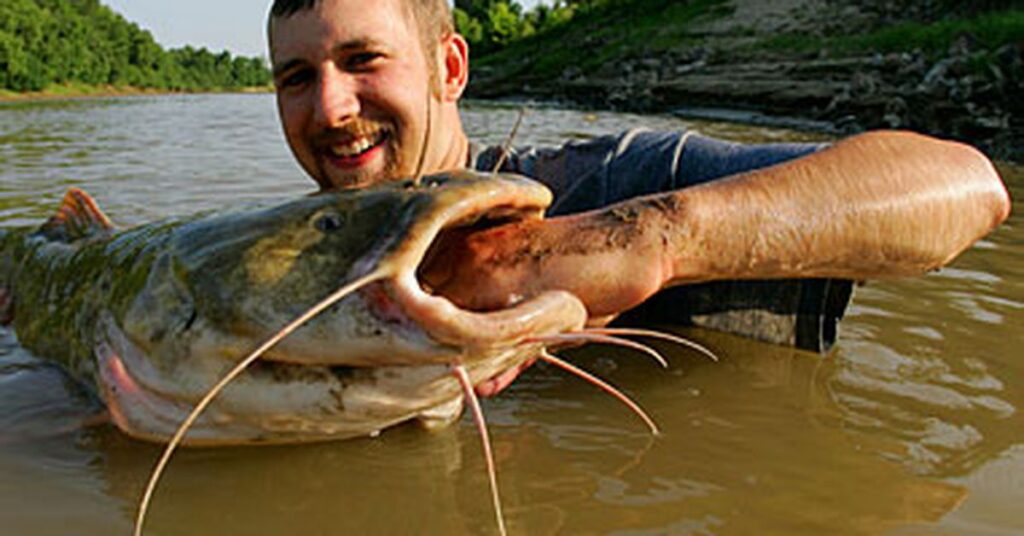
It was about this time that our menagerie began to swell. First there were the hens and ducks, then after a doctor recommended my brother not drink cow’s milk, we got a goat, which rode home with me and Chris in the back seat of our blue 1960 Chevrolet Bel Air, right down the main street of town. My mother, perhaps predictably, named it Nanny. Later we would add to our little zoo the hugest snapping turtle I have ever seen, which David caught while fishing; on another occasion I came home from school and headed into the bathroom to take a pee, only to jump out of my skin when I caught size of a three-foot-long catfish, alive and wriggling in water in the bathtub. David had caught it while “noodling” — a form of fishing in which you climb bodily into a muddy, opaque stream and physically pull giant fish out of the water with your bare hands. He later butchered it and nailed its giant head to a fencepost at the entry to our driveway.
And then there was our sweet little puppy, given to us by a friend of David’s whose actual name I forget but whose CB radio handle was Nailbender. This guy was really sweet, a gregarious Mexican man who was always smiling and laughing and going out of his way to engage us kids. And he looked like Freddy Fender, who was universally adored by everyone I knew at the time. (We had his singles and copies of his big hit album Before the Next Teardrop Falls on both vinyl and eight-track — and so did my grandma!) One day he brought us this adorable little doggy and I couldn’t believe we were going to get to keep him.
We called him Chico, Spanish for “little boy.” He was a mutt, a puppy not yet a year old, with soft cinnamon colored fur and a long pink tongue that he liked to slather all over my face at any opportunity. I played fetch with him out near the edge of the big empty field, throwing a stick which he retrieved over and over with fervor until finally that long tongue was dragging and we were both so thirsty we had to retreat to the house for water. I had never had a pet, never lived in a house with an animal, and I just instantly fell in love with this little guy.
And then came the afternoon maybe a week later, when I got off the school bus and made the walk down the long dirt drive to the house, only to find David standing on the porch looking very stern, smoking a cigarette with his shotgun crooked in one arm. I wondered if he had been out hunting, but his face told a story I knew was unlikely to have a happy ending. As I approached the house, my curiosity curdled into anxiety; my vision tunneled, my ears filled with a high-pitched whine like the sound of an old CRT television set being turned on.
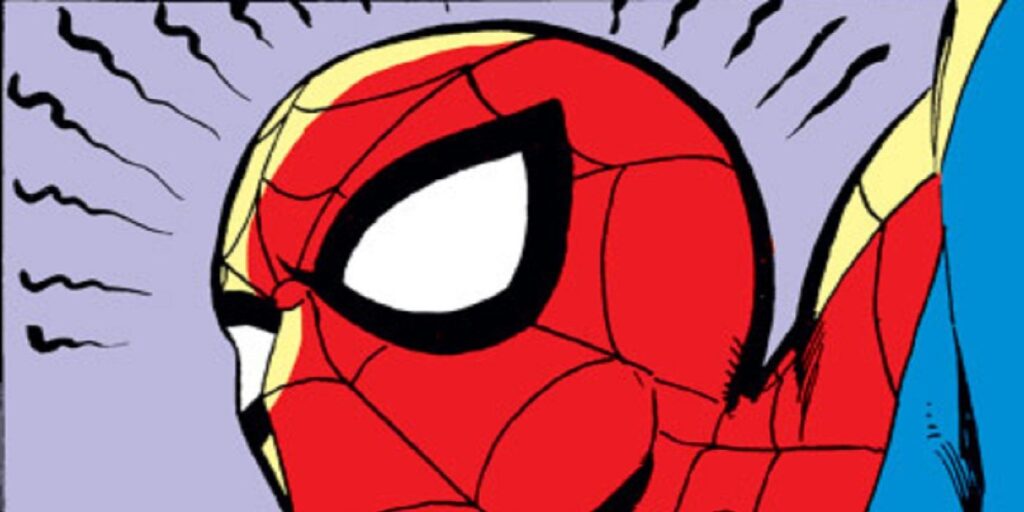
Is this what Spidey means when he says his spider-sense is tingling?
“Get in the house — and don’t look out the windows,” David said quietly. I knew better than to say anything, and did just as he said. I wondered if David was tangling with someone in town; he was often spouting off about someone who insulted him or pissed him off. Was he expecting trouble?
Inside the house I expected to be greeted by Chico but he wasn’t there. My mom must have heard me come in, as called to me from upstairs. I walked up the old narrow wooden staircase, at the top of which were two bedrooms, and found her sitting on her unmade bed, disheveled. The room smelled strange; I am sure now that she had been smoking pot but I had yet to learn about that.
“You’re home early,” she said, patting the bed next to her in an invitation for me to sit. I did not.
“Some kids weren’t on the bus today so it didn’t take as long,” I explained. “What’s Dad doing? Where’s Chico?”
My mother sighed.
“One of our chickens got loose today,” she said, “and Chico got ahold of it and shook it to death.”
I gasped, genuinely horrified to hear that my sweet little pup was capable of such a thing.
BLAM! The house shook with the blast of a shotgun from downstairs, followed immediately by a piercing, blood-chilling Yipe! that rose in volume and pitch and repeated over and over, a siren of agony — Yipe! Yipe! Yipe! Yipe! Yipe!
That was Chico!
I tore down the stairs and to the nearest downstairs window I could find, in the room next to the living room. There were still moving boxes and clutter stacked around in there and I had to fumble to get to the window. I didn’t want David to see me peeking, so I did my best to get any view at all without revealing myself. Through a crack in the drapes I caught a glimpse of my little dog limping across the grass of the front yard, with David pacing calmly behind him, shotgun in hand. Just as they passed out of my field of vision to the left, the Yipe! Yipe! Yipe! was abruptly cut short by one more bark from the barrel of David’s 12-gauge. The subsequent silence stretched out to fill the whole of the cosmos.
That evening at the dinner table nobody spoke. At all. I had no appetite but had learned to eat enough so that David didn’t beat me for that. Finally, with no provocation whatsoever, David set his ice tea glass down hard on the table and looked around at each of us.
“Once a dog gets a taste for blood, you can’t stop ’em from killing again,” he said, matter-of-factly. “I don’t want to hear a goddamn word about it.”
He went back to his plate, and the table relapsed into silence, and nobody ever did say a goddamn word about it.
Reading this so far, one might get the idea that life in the farmhouse was uniformly ghastly, but there were pleasures to be found, too. David really did make good on his promise of a dollar a week in allowance, and I quickly figured out that if I could find four pennies to cover sales tax, I could buy with that one dollar four separate items that each cost a quarter — and in those days that meant each week I could potentially come home with two brand new comic books and an ice cold glass bottle of soda pop and a candy bar, which I could then enjoy in the privacy of my hiding spot under the mulberry’s low branches.
My mother would take us on the weekend to the laundromat attached to Grose’s IGA — the one with the amazingly disgusting public bathroom with walls covered in classic Shithouse Poet graffiti and ceiling hanging heavy with stalactites of pastel pink and green and blue and yellow toilet paper wads that countless patrons had wet in the sink, then tossed up there to harden forever. While Mom did the laundry I would walk over next door to the adjacent grocery store to do my weekly shopping.
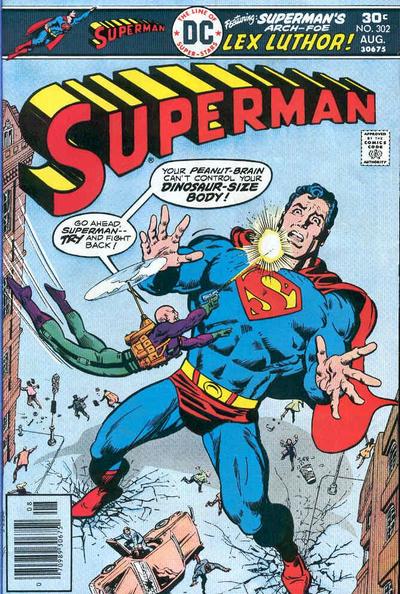
Which candy bar? The crispy Krackel, the decadent Milky Way, the sweet-and-salty Reese’s, the weirdo white-robed Zero, the super-stretchy Marathon, the crunchewy One Hundred Thousand Dollar Bar, good ol’ milk chocolaty M&Ms? This would probably be my one indulgence for the whole week, so I had to make it count. For soda I would usually choose Coca-Cola, or RC if they had it, because I actually liked it a little better. If there were flavored pops to be had I favored lemon, black cherry, root beer, sarsaparilla, ginger ale. And as for comic books, I divided my collection between superhero fare like The Amazing Spider-Man, The Incredible Hulk and Superman and “funny books” such as Richie Rich, Uncle Scrooge and various Archie titles. I remember being dismayed later that year when suddenly cover prices started going up to 30¢. First it was Superman, then the debut issue of Peter Parker, the Spectacular Spider-Man, then everything else. There went my system!
The end of the school year was coming up and I was excited at the prospect of a summer away from my classmates. I didn’t have a lot of friends among them and some were downright mean. One afternoon I was riding the bus home from school and Wings’ “Silly Love Songs” came on the radio. Looking out the window at the fields and farmhouses rolling by, I softly sang along with the chorus: “I— love— you—”
My reverie was shattered as the two girls sitting right behind me leaned over the back of my seat, one on each side of my head, and shouted in my ears: “We don’t love YOU!” I jumped out of my skin in surprise and just as quickly they retreated to their seat, both of them tittering gleefully. I looked up and caught eyes with the bus driver, reflected in the big mirror above the windshield, for just a second, but she looked away.
Around that time I was burning trash with David out on the back end of the property and I asked if he was looking forward to summer break as much as I was.
“Grown-ups don’t get to take the summer of from work,” he chuckled. “Once you’re out of school, you pretty much work until you die.”
I had never been so gobsmacked to learn something. I guess maybe I had spent too much time around the grandparents, because it had never occurred to me that most grown people worked all the time. It was a truly depressing realization.
“But we are going out to Hulah for Memorial Day,” David said, poking at the blazing barrel of garbage with a long straight piece of rebar.
This was exciting news! I had been to Hulah Lake once before as a smaller kid, on a weekend getaway with my grandparents. This meant swimming, probably grilled burgers or at least hot dogs, maybe there would be other kids? I was instantly sold.

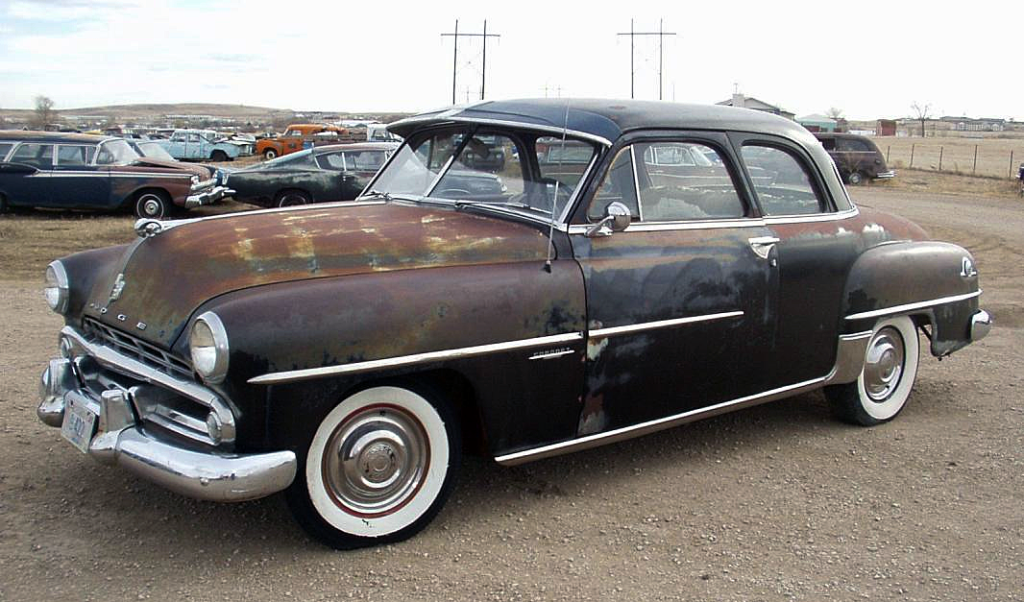
The next weekend, when it came time to head to the lake, David announced that we were going to make the trip in his old Dodge, which I had never even sat in. Built somewhere between 1950 and 1952 (I forget now), this car seemed massive to me, 17 feet long and made out of metal as thick and heavy as armor plating, black with a metal sun visor over the windshield. It resembled a huge black beetle, all business, even a little sinister. David had spent considerable time futzing under its hood since we had moved into the farmhouse and it looked like he intended this to be its big shakedown cruise.
Unfortunately, when he went out to do his preflight checks, David discovered that the car’s feeble old battery was dead as a doornail. This prompted a round of loud cursing, followed immediately by his jumping into the Chevy and tearing out down the driveway in a cloud of gravel and dust. My mom and Chris and I puttered around, our meager preparations for the trip already done, and waited for him to come back. It took a long time, as none of the parts stores in town had the right six-volt battery in stock and he had been forced to drive to Winfield, some ten miles away, to pick one up.
At any rate, it was dark by the time we headed out to Hulah Lake. The drive was to take maybe an hour and a half, two at most, as it was only about 80 miles, and David didn’t want to push the old Dodge too hard. I sat behind David in the huge back seat; my brother sat to my right, directly behind my mother. I stared out the window for a while but there was little to see and soon I became drowsy. Chris was already lying down and I joined him, arranging myself head-to-foot with him so there was room for both of us.
“There’s a blanket in the floorboard if you need it,” my mother said, turning to see us both settling in for a nap. But it was a pleasant night, not yet too hot but not cool enough to require a cover, either. My eyelids grew heavy and the drone of the big old straight-six lulled me right to sleep.
And then I was awake. The car was stopped, the engine off, and I was on my back on the floor of the car, looking up into the silence. It was pitch dark and it took me a moment to get my bearings at all. I heard indistinct voices in the dark. Are we at the lake? Why am I on the floor? I was still very drowsy, and drifted back to sleep, figuring the grown-ups would rouse me when it was time.
The next thing I knew, someone was gently shaking me awake. I opened my eyes and confusion instantly set in as I realized I had absolutely no idea where I was. I was lying on a pallet of blankets folded up on the floor of what appeared to be a spare room in a small, narrow house. Chris was sleeping next to me, still in his clothes from the day before. I realized I was in mine, too. How did we get here? Why are we here?
A strange older woman was kneeling over me. It was she who had stirred me from my sleep.
“Son, your mother was hurt pretty bad in the accident,” she said. The stark disorientation I felt in the moment had me a little scared but her face was kind and her demeanor calm, which provided a modicum of reassurance. She pointed to her left out the window. “I need you to run next door and ask the people there to call for an ambulance. Tell them we need it to come here to my place.”
I got up and asked her if I could use her bathroom and I remember there were mirrored tiles on the walls everywhere with little glittery plastic starbursts around the screws in the corners. I took a pee, then walked out her door and was surprised to see that we were in a mobile home, with a steep set of concrete steps leading down to the ground below. The sun was just coming up — What time is it, anyway? There was still a snap of chill in the air, the last vestige of fleeting spring weather before the heat of another Kansas summer set in. I saw that the nice lady’s trailer was in a neat little park with several others.
Where am I? Where are Mom and David? Where is the car? Who is that lady? What did she mean, accident? What accident?
I can still recall the sound of the gravel under the rubber soles of my cheap canvas tennis shoes, the sensation of the individual stones pressing up against the bottom of my sockless feet inside with each step. I hoped whoever lived in this next trailer wouldn’t be mad at me for waking them up so early. I mounted the steps, knocked, and an elderly man who reminded me of my own great-grandfather answered the door, bleary-eyed, a bathrobe half-tied around him.
“Hi,” I said. “My mom was hurt in a car accident, and the lady next door” — here I pointed at her mobile home — “sent me to ask you to call for an ambulance at her address.”
Once again this is where a really vivid memory of mine peters out entirely. I don’t remember seeing my mother again that day, nor David, nor Chris, nor the car. I know we didn’t go to the lake but I have no memory whatsoever of how we ended up getting back home, either.
Both David and my mother had been injured in the crash, which it turned out occurred when someone crossing the highway on a county road ignored their stop sign, darting out directly in front of the Dodge’s frail headlights and getting t-boned in the process. David’s balding pate had smashed into the windshield, shattering the glass and cutting himself up pretty good. He had reflexively thrown his right arm up in front of my mother to shield her from the same fate, but lamentably, his forearm caught her right in the throat, half-crushing her larynx. (This would go on to transform my mother’s already-masculine baritone voice into a hoarse rasp for the rest of her life.) I am not sure now what treatment my mother underwent, but she wasn’t down for long. Before I knew it, things in the house had pretty much gone back to normal, except for the conspicuous absence of the big black Dodge.
The summer went on, indifferent.
On a hot Sunday afternoon in maybe late July or early August, I was helping David dig a hole in the yard south of the house, where he intended to build an in-ground barbecue pit. Just yards away the big field that bordered the house to the south and west was now fully planted up with milo, acres and acres of the stuff. My mother was inside the house, roasting a chicken; my little brother Chris was outside running around as usual. It was a moment of relative calm in the household, as both Mom and David had noticeably less energy after the car crash and the yelling and violence had subsided to a degree, even as they both recovered. I think in my little heart I was hoping maybe the crash had taught them some sort of valuable lesson. If only.
Suddenly Nailbender came roaring up our driveway in his old early-’50s Chevy pickup, bright yellow with dingle balls around the inside of the cab, a Mexican blanket seat cover and the classic barefoot gas pedal. I loved that old truck and I liked him, too; what was he doing here? He parked his truck, jumped out and hollered across the yard at David, who looked me in the eye, pointed to the hole and walked off to meet his friend. I knew this indicated that I was supposed to keep digging, so I did. The two men went into the house and I tried my best to be productive, but I was just seven and there was only so much dirt I was able to get out of the hole, especially now that it was a couple feet deep and the earth seemed to be getting harder. I kept at it anyway. I wanted to show David that despite his admonitions, everything I touched didn’t necessarily always turn to shit.
A few minutes later, Nailbender ran out the front door of the house, hopped in his truck and tore out. My mom poked her head out the back door and called to me.
“Mike, get in here,” she hollered. “We’re going to Texas.”
I was perplexed.
“When?” I yelled back.
“Right now!” she replied. “Now get your ass inside and help me get ready.”
And literally within about 30 minutes, the four of us were in the old blue ’60 Chevy, which my grandparents had given my mom when she and David got married, and we were off to meet up with Nailbender for this impromptu road trip. I guess I thought he was going to ride in the car with us, but when we got to his house it was revealed that his girlfriend, a white hippie lady who I think was named Sherry, would be joining us, as would her three school-aged sons. I had met these boys a time or two and we were on friendly terms, so it seemed like a winner to me — until all five of us kids were expected to ride in the back seat of the one car!
But then we were off, our old Chevy sedan following their old Chevy truck down the two-lane highway. There was music on the radio and things to see out the window as we rolled over the border into Oklahoma and southward across the red dirt that had been Indian Territory in my great-grandfather’s day, not so long before. I counted three different truck stops along the way, each of which had a large banner or painted pane of glass that blared out WE HAVE TEXAS TOAST in bold red capitals. I didn’t even know what Texas Toast was, but I was about to get the opportunity to find out.
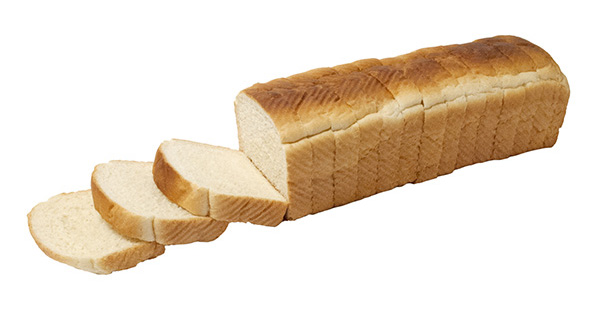
David and Nailbender communicated throughout this trip via CB radio, sometimes just cracking wise with one another, other times discussing fuel stops or other navigational matters. They had agreed beforehand that we would stop somewhere to eat, and as we approached the third of the aforementioned truck stops, our radio crackled and Nailbender suggested we pull over there.
Inside, the waitress and a busboy scooted several tables together to accommodate our party of nine. Nailbender sat at one end, just to my left, and it was clear he was impressed that I could read the menu. I wrinkled my nose when I saw the phrase “hash browns,” having had corned beef hash once and finding it truly ghastly.
“What’s that for?” asked Nailbender with a chuckle. “See somethin’ you don’t like?”
“What are hash browns?” I asked.
“What!?” he exclaimed in surprise. “It’s like, fried potatoes, man. You don’t like fried potatoes?”
My outlook changed immediately, as of course I loved fried potatoes. I nodded in the affirmative.
“Yeah, man,” Nailbender said, “sometimes they’re like shredded up and sometimes they’re just diced in little teeny cubes. Good either way.”
I knew what I wanted to order but didn’t know if I was going to be able to get it, as we didn’t really go to restaurants that much and I didn’t know if I was expected to eat some kiddie-menu selection, but I looked over at David and without prompting he said, “Order what you want.” I don’t think I had ever told my own order to a server before that, and I was feeling pretty pleased with myself when I ordered eggs over easy with bacon, hash browns and Texas toast — and a root beer to wash it down.
It was maybe the best breakfast I had ever eaten in my life.

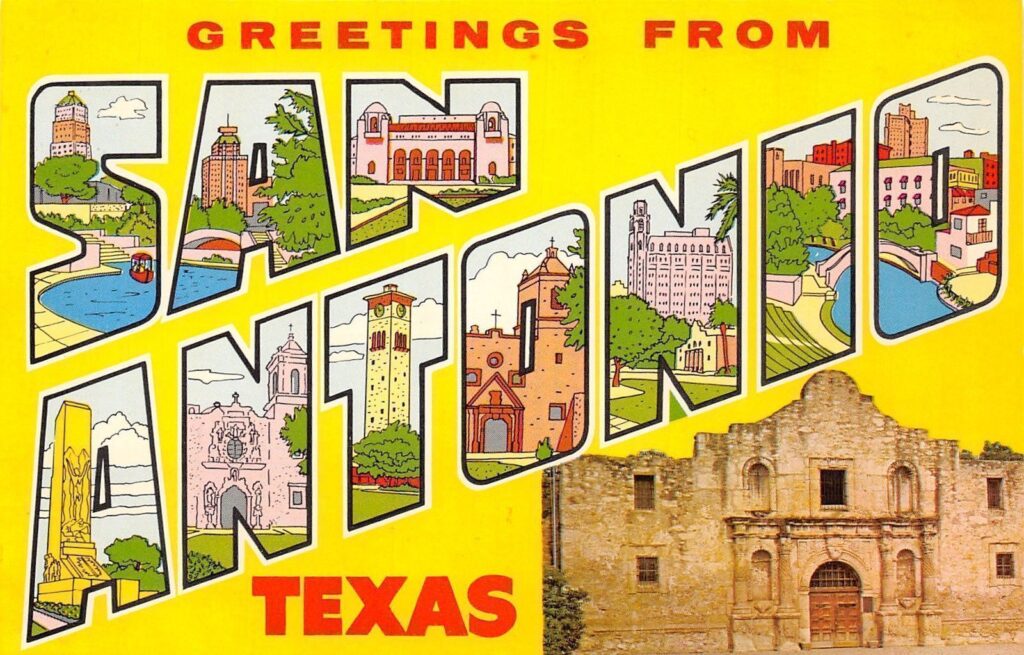
We got to San Antonio some time after midnight. One of the kids had moved to the front seat and another to the pickup, so there were only three of us left in the back of the Chevy, and we had all been dozing for some time when we pulled into the parking lot of a Motel 6. We shuffled into a stale, small motel room and passed right back out.
In the middle of the night, we were awakened by sirens and lights outside our motel door. David stumbled out to see what was going on and the room filled with bright flickering light. A car was ablaze in the parking lot! A cop came around while David stood there in the doorway in nothing but his briefs and told him it was safe to go back inside, which he did.
The next couple of days plays in my memory like a montage from a movie — strong visual recollections that start out of nowhere and fade into the next with no continuity between vignettes, nor closure for any specific scene.
First there was the trip downtown. The MacGuffin for this whole bananas drive to San Antonio was Sherry’s need to appear in a building downtown there at a certain time on that specific day. Years later I deduced it was probably a court date, though nobody ever said such explicitly. But the upshot was that the place she was going was near the Alamo, and I really wanted to see it. None of the other kids were interested, and I think some were still asleep, even. Nailbender was still tired from the drive and stayed behind, too.
David, Sherry and I got into the Chevy, leaving the rest of the crew in the motel, and headed toward Sherry’s destination. We dropped her off in front of a large municipal-looking building and as she trotted away I noticed for the first time just how huge were the bell bottoms of her jeans, flopping back and forth with each step she took.
“All right, kid,” said David. “Come up front. Let’s go find the fuckin’ Alamo.”
I clambered over the backrest of the front seat and plopped down in the shotgun position. As much as I had come to fear and mistrust David, I was still a little boy looking for an approving father figure, and he could be surprisingly gentle and generous and funny and even sensitive. I was very happy to be invited up front. Now it was just us guys driving around historic San Antonio, looking for the site of one of the most famous battles in American history. Father-and-son-stuff, right?
As we drove, we kept seeing this crazy Space Needle-looking building. I finally asked David what it was.
“I can’t remember what it’s called,” he replied, “but there’s a restaurant up in the top of it that spins around.”
I had never heard of such a fantastic thing in my life and half-wondered if he was full of shit, but I chose to believe him because I wanted it to be true. I was still pondering the deeper implications of the sky-high revolving restaurant when David suddenly pointed to the right.
“There it is,” he said.
I looked where he was pointing, and sure enough, we were driving past the Alamo. Wow, that’s it? I don’t know what it was exactly I had expected; I think I had imagined it to be much bigger. At any rate, a few seconds later, it was behind us.
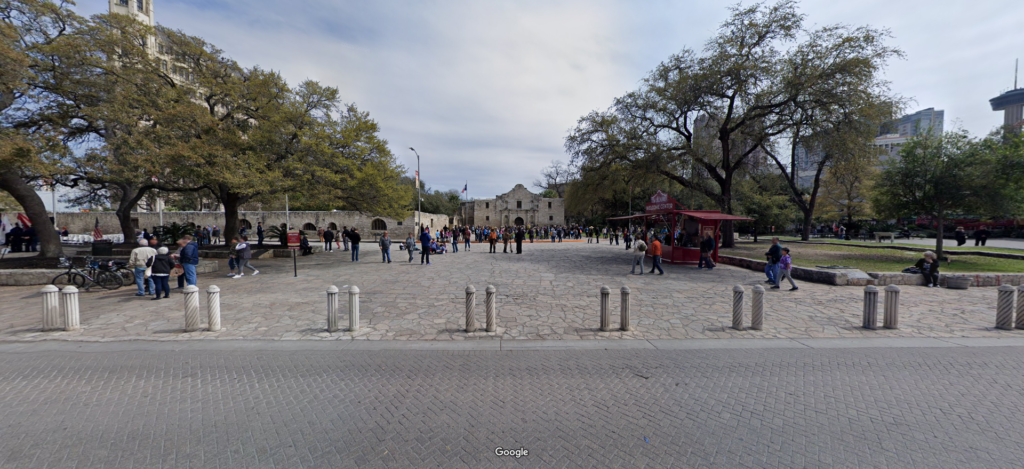
We slow-cruised around the area looking at buildings and people for a little while, then circled back to find a parking spot near where we had dropped of Sherry — but when we got there she was already done with her business and was waiting for us on the sidewalk. David pulled the Chevy up to the curb and I prepared myself to move to the back seat, but Sherry hopped in behind me without a second thought. I felt like a king!
The next thing I remember is being at a complex of newish townhouse apartments, where some friends of friends lived. Nailbender and Sherry seemed to know a bunch of people down there, and they were all apparently very laid-back. I don’t know where everyone in our group was at this time, but I was super jazzed to find out that Chris and I were welcome to use the lovely outdoor swimming pool in the center of the place. It was a very hot day and we must have stayed in the water for two hours (completely unsupervised!) wearing the same cutoff jean shorts we had been in since morning.
When we went back inside the apartment, the air conditioning on my wet skin flash-froze me to the bone like a bag of Birdseye peas. There was music playing and incense burning. I don’t remember what the lady who lived there looked like but she was nice and gave me and Chris each a big fluffy towel. I dried off and found my mother sitting on the carpeted steps of an open-sided staircase — like on The Brady Bunch — with a cigar box in her lap. I approached her to see what she was doing, and she raised her eyes to mine.
“Now, you can’t tell anybody about this,” she said as I finally made out what she was doing — hand-rolling what I assumed to be a cigarette out of the contents of the box. I had never seen her do this before, but she did smoke a lot of cigarettes, so I wasn’t entirely surprised.
“Why not?” I asked.
“Because,” she replied, leaning in a little toward me, “it’s against the law.”
“What? I’ve seen cowboys roll cigarettes in movies a million times.”
“Yeah, well,” my mother said, lowering her voice conspiratorially, “this isn’t tobacco.”
The next scene takes place in a house I think must have been somewhere on the outskirts of town. We were invited to a barbecue in the backyard of this low, flat, white house that looked a little like an old commercial building of some kind. I was amazed when I entered the massive, open kitchen of the place and found the whole worn tile floor emblazoned with a decades-old Lone Star Beer logo. I asked several of the grown-ups there about it and one finally explained that the house had once been a roadhouse, a place where people came to drink beer and dance to real live musicians playing country music. I had heard my grandmother tell so many stories about hitchhiking across Oklahoma in the 40s to get shitfaced and dance to Bob Wills and the Texas Playboys; I was immediately gratified to hear of this place’s provenance, and I imagined how many hundreds or maybe thousands of people had two-stepped across this old floor in the years long before I was born.
There was a little girl there about my age, too, named Libby. She showed me around and we played in the backyard, where I found a bunch of mummified old snail shells. Eventually there was barbecue and we sat around big wooden outdoor picnic tables. The adults drank and laughed and someone was playing records on a portable turntable set up on a chair in the yard. I had heard songs from the Wanted! The Outlaws album before but this was the first time I saw the actual cover art. Who is Tompall Glaser?
David starting getting antsy about getting back on the road, as it was about a ten-hour drive and he was full of brisket and beer and probably feeling sleepy already. Nailbender wanted to wait until it got closer to dark, as it had been so hot driving down the day before, and he and David were both night owls anyway. So we ended up farting around at the old roadhouse until probably seven o’clock.
The nine of us once again piled into our two old Chevys and prepared to hit the road. We stopped for gas, and just as I thought we were about to mount the big highway and put the pedal down for points north, the CB crackled to life with Nailbender’s voice once again. He said he wanted to make one last quick pit stop on the way out of town, to pick up some of his favorite fried chicken.
We pulled in side by side at a Church’s Chicken location. I had never heard of the place but I guessed it must really be good. David decided he would get a drink for the road, so he hopped out of the car just as Nailbender was exiting his truck to our right. Just then a Volkswagen Beetle swung really fast into the parking space directly in front of our car, coming very close to hitting David and potentially smashing him against his own front bumper. David tried to jump out of the way and flopped backward onto the hood of our blue Chevy, jostling the car and getting all our full attention.
Nailbender, whom I had never seen being anything but jolly, suddenly scowled and stomped toward the guy in the VW, who was more likely guilty of inattention than malice. He got to the guy’s door and leaned his big mustachioed face into the driver’s side window just as David, who had managed to get to his feet, came up behind him.
I couldn’t hear everything that was being said but more or less Nailbender was giving the guy an earful: “What the fuck do you think you’re doing coming into the parking lot like that, you fuckin’ maniac, you almost hit my buddy here!” The guy didn’t dare get out of his car, but his body language showed remorse and supplication, and for a moment it appeared that would be that. But then their voices started getting heated and Nailbender grabbed the guy’s door handle and tried to open it. The VW driver started to look panicky. He quickly cranked up his window. Nailbender insisted the guy get out of his car, but it wasn’t happening.
David, who had been standing behind his friend this whole time, grabbed hold of the underside of the VW’s driver-side fender and started to rock the car. The driver’s panic level escalated dramatically. Why doesn’t he back up and drive away? It took me back to that moment in our garage the past spring, when David had pointed the pellet gun at me — the paralysis I experienced in the grip of that sheer mortal terror— and I felt for this poor sap.
“Oh my God, David, don’t get us arrested in Texas,” my mother clucked from her spot in the front passenger seat.
Suddenly Nailbender followed David’s lead, leaning down to grab the fender, too, rocking the hell out of the little German car, now twice as hard. He said something to David, cocking his head to the left, and David nodded. Both men stopped their rocking and repositioned themselves in front of the car. They reached down and grabbed the front bumper and heaved, and the whole front end of the Beetle shuffled just a couple inches toward port. The men heaved again and this time they made another six inches or more. As the driver inside the car yelled indistinctly through the glass at them, they managed to drag the VW’s nose around just about 60 degrees, so that the car was now almost sideways across two adjacent spaces, on either side of which was another parked car.
David and Nailbender yelled expletives and insults and gave the guy the finger as they ran back to their respective vehicles. We tore out of that lot just as the manager of the Church’s ran out the front door yelling that he had called the police, and my very last memory of San Antonio is seeing the guy in the VW crawl out with his shaking fist raised in the air, screaming, “Fucking beaner!” at the top of his lungs as we burned rubber out of there.
We didn’t make it all the way home in one shot that night; nobody had enough stamina to stay awake for the whole drive. We pulled into a rest stop somewhere in Oklahoma and slept in our vehicles until the sun was well above the horizon. I heard the grown-ups talking and it sounded like everybody in the group was about out of cash and we would probably be lucky to have enough gas to make the trip. There was no Texas Toast and hash browns this time; instead we split a few snacks and a couple bottles of soda pop, purchased from vending machines at the rest stop. There was little to no conversation on that last stretch of the drive, just the sounds of music on the AM radio, the hum of the engine, the whirr of bias-ply tires on asphalt, the steady roar of the wind. Soon we were back over the Kansas line and by early afternoon — almost exactly 48 hours after we had so hurriedly left — we were home again.
Upon walking into the house we were greeted by a horrific odor. I had never smelled anything so foul. David immediately went on guard, suspecting someone may have been in the house during our absence. He carefully poked his head around doorways, peering into the corners and sniffing at the air for clues.
It was my mother, however, who sussed out the source of the stench. When Nailbender had come to invite us on the road trip on Sunday, she had been in the middle of roasting a chicken. In the sudden flurry of activity that preceded our hasty vacation from the premises, she’d had the foresight to turn off the gas oven — but not to remove the half-cooked bird inside it. Even without the oven on, the interior of the old farmhouse was still 100 degrees the whole time we were gone, and the chicken had become quite ripe indeed.
But the smell, though truly sickening, wasn’t the most visceral part of the horror of walking back into the kitchen that day. What I remember most vividly of all was a big nasty hanging fly strip, positioned directly over the table where we ate our meals, so encrusted with living flies that the whole long adhesive strip wriggled and writhed and buzzed audibly like one massive Lovecraftian abomination.
David wrapped a red bandanna around his face to cover his nose but it can’t have had much effect against that stink. He held his breath, reached into the oven and pulled out the roasting pan with the rotten chicken inside, then quickly marched it out the nearby back door, straight to the hole we had been digging on Sunday. He dropped the whole pan in there, grabbed the shovel from where I had left it sticking in the earth and began frantically covering the noxious parcel with dirt.
We were home, such as it was.